EDI is Attending IMC 36th International Maintenance Conference

EDI is Attending IMC 36th International Maintenance Conference

Electronic Data (EDI) will be exhibiting at the 36th International Maintenance Conference (IMC) 2022 in Marco Island, Florida!
In partnership with Maximo® as a Service (MaaS), EDI provides clients with our innovative Strategic Asset Management (eSAM) version of Maximo using industry-leading hosting infrastructure and services. This partnership enables us to offer a true turn-key Enterprise Asset Management solution in the cloud for our customers, allowing them to focus on executing their asset maintenance and request management strategies rather than configuring, maintaining, and administering an IT system.
Be sure to stop by Booth #316 and learn how EDI can help you increase more wrench time with less data entry!

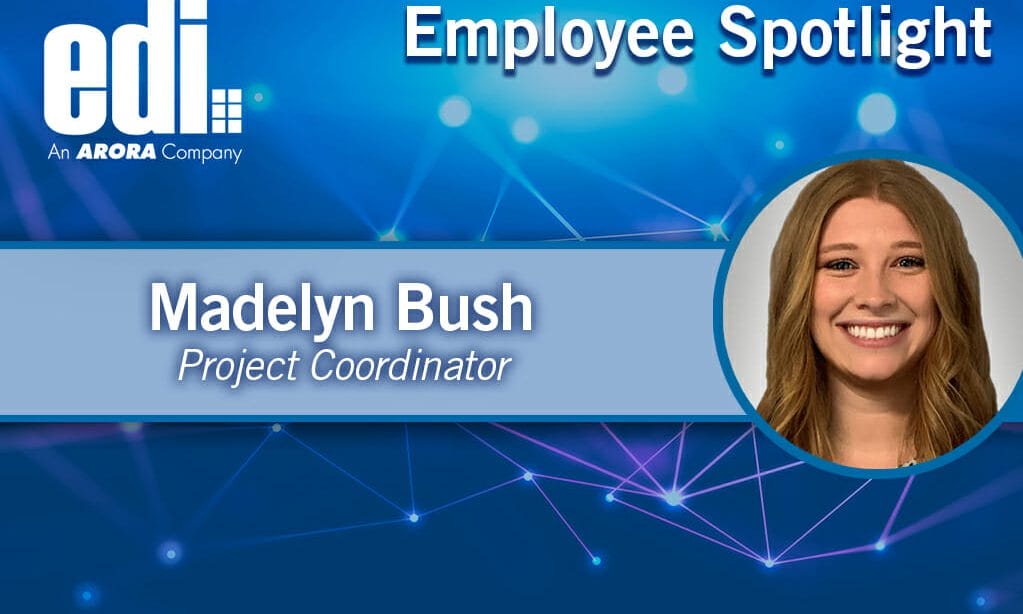
Employee Spotlight: Madelyn Bush

Madelyn Bush

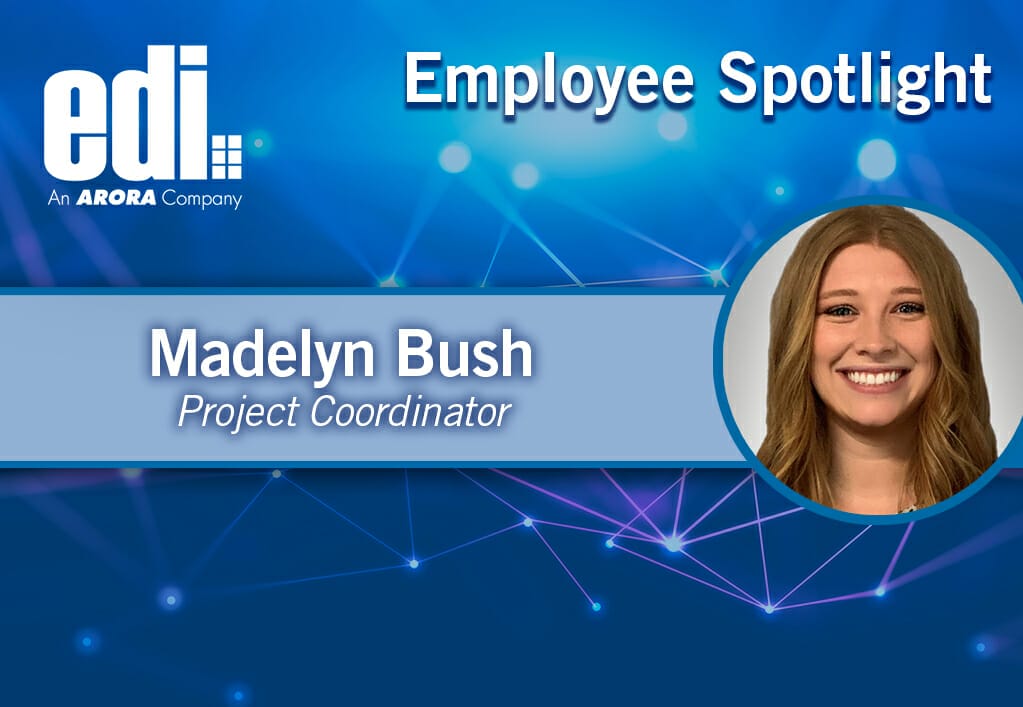
Employee Spotlight: Madelyn Bush

Madelyn Bush

1. How did you come to do what you do? 

I started working as a proposal coordinator for an aviation composite supplier, and from there I interviewed with Arora and got the job here at EDI.

2. Was this a lifelong goal?

I’m not sure anyone reaches lifelong goals at 26. If they do, I need to talk to them!

3. What motivates you every day?

I find a lot of motivation in knowing that what I’m doing is making a difference to someone (or several people). 

4. What makes you unique and different?

I’m probably the most positive person on a regular basis that I know. I almost always steer away from the negative to try and find excitement and value in the day to day. 

5. What are your favorite types of projects to work on?

I mostly work on projects of the same goal, but I’ll go a step further and say that the best part of that is seeing when all of what the team has been working on intersects with the customer team finding that the changes we’re making for them are going to be helpful and provide a lot of value. I can’t wait to watch that continue as some of the projects I’ve been assisting with since I started come closer to their launch into go live.

6. What are your future career goals?

I always thought I’d be working in Marketing or some sort of social, internal capacity. The more I work in Project management, I see definitely a path forward here, too, and I’ve really been enjoying learning the process and working with the team and clients.

7. What is the best career lesson you’ve learned so far?

I think something I do very well because I had to learn it in a previous role is time management. Accompanying that would probably be taking notes on everything. It’s incredibly important and saves a lot of time and stress for everyone when everything is written down and can be referred to. 

8. Tell us what your day-to-day looks like at EDI?

My day-to-day consists of a mixture of team meetings to go over project updates, assisting in solving support tickets for projects and getting project hours up to date and accurate, and overall assisting the project managers.

9. What do you enjoy most about working at EDI?

Everyone who works for EDI is very goal driven and extremely kind. It makes for an excellent work culture, and I can’t wait to see more people join the team. 

10. What has been your favorite memory while working at EDI?

I was asked to assist with a conference recently, and that was a blast. I got to meet several clients I’d been working with virtually, learn more about Maximo and made personal connections with other attendees that all work in the industry.

11. Outside of work, what do you like to do for fun?

I play on a softball team on Sundays and do CrossFit or yoga most days, spend time with family. I also love going to see movies, reading, and taking my dog on walks or to the dog park.


LinkedInTwitterFacebookEmail

Buy Your Data the Right Way on Your Next Capital Project

Buy Your Data the Right Way on Your Next Capital Project

Buy Your Data the Right Way on Your Next Capital Project

Buy Your Data the Right Way on Your Next Capital Project

A capital project is an investment that builds on or improves a capital asset. They are typically large in scale and cost and involve significant resources and planning to complete.

What is a Capital Project?

A few examples of capital projects are airport terminals, railways, and roads. In the case of a capital project for a corporation, you might see the development of a facility  instead. A corporation allocates both financial and human capital to build or maintain new assets, and it’s not unusual for these types of projects to be planned for months or even years to make sure execution is seamless.

Data Analytics

Data analytics are crucial for monitoring, analyzing, and auditing capital project costs, as such analytics can provide insights on cost and schedule performance – along with a number of other trends – no matter the capital project at hand. 

Even though data-driven management for digital capital projects is a useful tool, it’s a tool that has yet to be optimized by most organizations. Old methods are still going strong, and many industries are wary of sharing their real-time data.

The FMI Report1  found that 95.5% of all data goes unused in engineering and construction, which can result in tremendous hidden costs for owners who often fail to consider the significant amounts of usable digital asset data that is created, used, paid for and then discarded when the project is handed over from the construction and design team.

These costs are incurred when, after their capital project is complete, those very same owners then pay to create a whole new set of identical digital asset data needed to implement asset management, work order and other key software systems relied upon to run their new facility. Therefore, they pay again for the very same data already created and left behind during the construction and design process.

Solution

Help bridge the gap between the capital project acquisition process and facilities management to ensure your facility is ready to go on day one with all the data needed to run a world-class operation utilizing data interoperability.

Establish data standards and templates at the outset of our capital project to ensure you receive the facility, system, and asset-related data needed to feed your Enterprise Asset Management (EAM) system and lay the foundation for predictive maintenance. 

When you use data interoperability to establish the foundation for your data analytics and buy data the right way on capital projects, your corporation can see a number of benefits. These benefits include:

  • The optimization of the systems and processes that your business currently uses.
  • The ability to predict demand in the future.
  • Improving facilities asset management.
  • The ability to prioritize capital investment where it counts.
When you use data analytics, your corporation can save significant time and money. Utilizing sophisticated analytics allows you to increase automation, utilize effective controls, and improve regular data monitoring across your company.

Getting insight from past performances to make future decisions can greatly impact your company. It allows you to predict trends more accurately, learn from past actions, and create more successful solutions. You can generate value with an analytics strategy that identifies, sizes, and prioritizes the enormous opportunities for your corporation, making strides towards a profitable future.

Understanding the Power of Data

Buying data and using it correctly gives your company the power it needs to move forward productively. It’s time to move into the future with the rest of the business sphere – don’t get left behind. Instead, utilize data analytics for your next capital project.
LinkedInTwitterFacebookEmail

5 Things to Consider When Choosing a Mobile Solution for Your Facilities Management Operations

5 Things to Consider When Choosing a Mobile Solution for Your Facilities Management Operations

5 Things to Consider When Choosing a Mobile Solution for Your Facilities Management Operations

5 Things to Consider When Choosing a Mobile Solution for Your Facilities Management Operations

Updating your organization’s network of tools and services to facilitate real-time facilities management operations sounds easy enough at a glance. However, there are so many mobile solutions available in today’s market that exploring your mobile management options can quickly become daunting. 

As such, it’s wise to step into exploring different mobile solutions with a strategy in mind. Consider the following points while searching for an enterprise mobile solution so that your company can streamline facilities management operations and invest in a service that meets your every business requirement.

#1- Unique Operational Requirements

A significant variety of mobile solutions exist in today’s market, so to condense the number of solutions to choose from, business owners need to evaluate their unique facility management needs.

For example, when searching for mobile solution offerings, determine whether your company requires the following features and whether they’re available through the management and/or maintenance operations software you’re considering:

  • Data Collection & Analysis
  • Real-Time Facilities Management Capabilities
  • Order Management
  • Vendor Management
  • Asset Management
  • Inventory Planning
  • Maintenance Scheduling
  • Work/Labor Tracking
  • Document Storage/Organization

Organizations should also ensure the system provides a “Single Pane of Glass” where facility managers can view all of their smart and connected building system asset data in one place. Facilities are investing more capital than ever in smart and connected building systems, but to access this critical data, technicians and FM leadership often have to engage with multiple OEM apps to gather the appropriate information. . The best mobile solutions combine smart and connected asset data from the manufacturers and the systems themselves and allow facility managers to save time and money by combining all of this data into one easy to use information platform, eliminating the need to train staff to use multiple manufacturer platforms to extract necessary data.

#2- Integration Capabilities

Integration capabilities are critical for organizations that have already implemented a selection of programs and tools to streamline company functions. Discovering whether an enterprise mobile solution can be integrated with the current software is necessary for reducing complications and streamlining the process of adopting new programs.

#3- Support and Training

Many organizations are experiencing a “brain drain” post COVID, with large swaths of tenured staff retiring or facing leveraged buyouts to cut costs, resulting in many organizations losing critical institutional knowledge. The right mobile tool can help bridge the gap by collecting this information within the system which can then be passed down to the next generation of staff.

The timeline needed to learn how to use new software may decrease productivity in already overwhelmed workplaces, and ineffective training often leads to errors and delays. As such, training is an essential part of workplace efficiency, especially when using new tools and programs. Working with a mobile solution provider that offers support and training throughout implementation can help ensure that each user is informed about software functions and knows how to initiate each process they’re responsible for.

#4- User Interface and User-Friendliness

Even if a particular maintenance operations software covers every function your organization could ever need, implementation will not be a success if the software is too cumbersome to use. Choosing a user-friendly program with a clean interface can greatly simplify learning how to use the new software. Preventing employees and other team members from becoming overwhelmed is an ideal way to streamline information retention and avoid complications. An easy to use solution is essential because it encourages teams to more easily adopt the new technology as a natural part of their day-to-day operations.

#5- Security Measures

Finally, adequate security protocols are imperative when introducing real-time facilities management software to your organization’s network of tools. Protecting your company’s data from unauthorized access, theft, alteration, or loss helps secure the information your business depends on to function. It also simplifies security processes and frees up human resources so that employees can be dispatched to more engaging tasks.

In addition to researching solutions on your own, there’s an added benefit when providers offer product demonstrations. If you’re searching for a mobile solution to streamline your facility management operations, viewing a demo or speaking with software professionals will likely make your decision much more straightforward.

LinkedInTwitterFacebookEmail

EDI Awarded Best Maximo Asset Information Management at MaximoWorld 2022!

EDI Awarded Best Maximo Asset Information Management at MaximoWorld 2022!

EDI was honored to be recognized at the 2022 MaximoWorld conference in Austin, Texas for Best Maximo Asset Information Management project. This award was presented to EDI and Kansas City Airport (MCI) for our Enterprise Asset Management (EAM) Implementation work on the New Single Terminal and Parking Garage at Kansas City International Airport.

The new $1.5 billion terminal is the largest single infrastructure project in Kansas City history. MCI’s modern 1M SF single-terminal will debut in early 2023, and feature 39 gates, updated amenities and dining options, and the addition of a 6,300-spot six-level parking garage with covered commercial curb connects to both levels of the new terminal via roadway crosswalks on each level.

MCI applied an innovative approach to implementing asset management at the very beginning of the new terminal project. EDI, along with Arora Engineers (Arora), worked to ensure that operations and maintenance staff were in a position to use and maintain the entire new facility (the organizations most critical asset) from day one. MCI was therefore able to reduce their implementation costs by approximately 50% with a digital delivery compared to a traditional asset management implementation.

This is the third year in a row EDI has received a MaximoWorld award. Last year, EDI and Salt Lake City International Airport (SLC) were awarded for Best Maximo Enterprise Asset Management Implementation Program at MaximoWorld 2021.

Congratulations to our team on this terrific accomplishment!

To learn more about our work on the new terminal project, as well our Data Interoperability Services and how facilities can protect organizations from losing data when datasets are created, read our case study.

LinkedInTwitterFacebookEmail

Upcoming Event: EDI Exhibiting and Speaking at CFTA Annual Conference 2022

CFTA-Annual-Conference-2022_slideshow

Upcoming Event: EDI Exhibiting and Speaking at CFTA Annual Conference 2022

CFTA-Annual-Conference-2022_slideshow

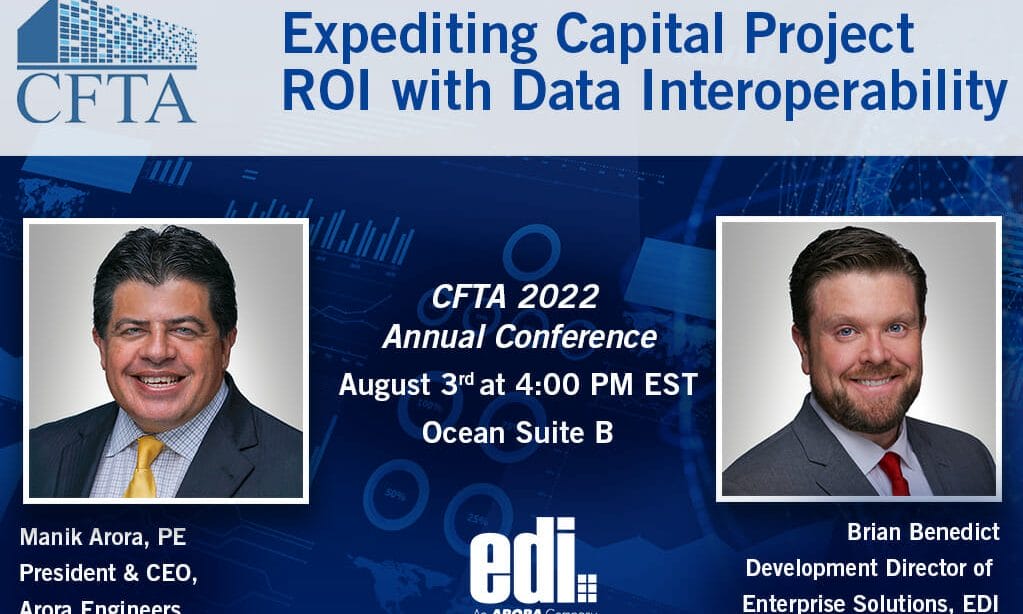
EDI will be exhibiting and speaking at the upcoming CFTA 2022 Annual Conference hosted by Brown University in Providence, RI from August 2-5, 2022.

CFTA brings together campus FM technology professionals and solution leaders for four days of engaging educational sessions, round table discussions, networking, campus tours, and community fun in a collaborative environment. Attendees will learn and discuss best practices, hear about the latest innovations, shape the future of work, and feel energized to design and manage campus systems navigating the path forward.

If you are attending, stop by our table to meet our team and learn about an easier, more accurate way to manage Operations & Maintenance work order requests for your facility with Arora ATLAS® Request, as well as our Data Interoperability solutions to enhance your capital projects.

Session Information:

Manik Arora, PE, President and CEO of both Arora Engineers and EDI, and Brian Benedict, Development Director of Enterprise Solutions at EDI, will be presenting “Expediting Capital Project ROI with Data Interoperability” at CFTA’s annual conference.

EDI’s technology experts achieve data interoperability by establishing data standards and specifications to ensure facility managers can integrate asset data created during construction into their Enterprise Asset Management system to seamlessly maintain their facilities. Our experts will explain how you can integrate your BIM/CAD, GIS, and asset data into one network for a consistent flow of valuable data needed to increase operational efficiency, decrease costs, and enhance user experience. Be sure to attend and learn more!

Date and Time: August 3rd at 4:00 PM EST

Location: Ocean Suite B, Graduate Providence Hotel

LinkedInTwitterFacebookEmail

Upcoming Event: MaximoWorld 2022

Upcoming Event MaximoWorld 2022

Upcoming Event: MaximoWorld 2022

Upcoming Event MaximoWorld 2022

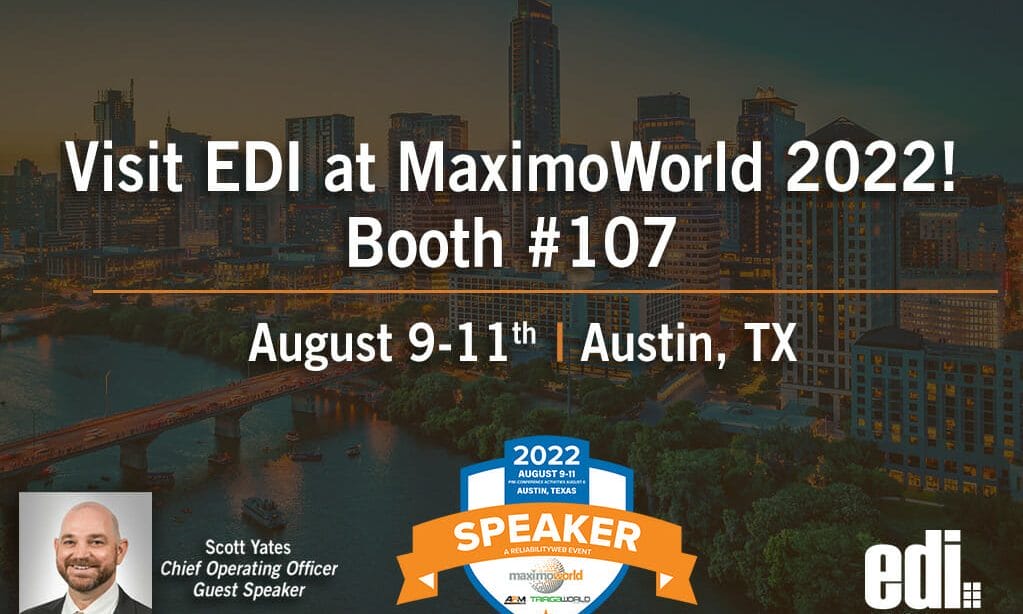
Electronic Data (EDI) will be attending Maximo World 2022 in Austin, Texas! Be sure to stop by booth #107 to meet the team and learn how you can save time and money with Data Interoperability Services!

EDI’s innovative Data Interoperability process prevents Owner’s from paying twice. Our team helps bridge the gap between the capital project acquisition process and facilities management to ensure our client’s facilities are ready to go on day one with all the data needed to run a world-class operation – all while saving millions of dollars over the life of the project and the facility.

To register for this event, click here.

Session Information:

Scott Yates, Chief Operating Officer at EDI, as well as Ian Redhead, Deputy Director of Operations & Maintenance at Kansas City International Airport, will be presenting “Kansas City Data Interoperability and Road to Digital Twin” at Maximo World 2022.

For as long as facilities have been built, there has been an immense challenge for organizations to acquire, assimilate and organize the data required to properly operate and maintain a facility that has been turned over to them. We all know the story, by the time a project reaches the stage of commissioning the facility and turning over the “as-built” drawings, equipment specifications and manuals, the project’s budget, schedule (and patience of the people involved) have long been expended. Organizations are left with a hodge-podge of information on their new facility and are left on their own to gleam the useful information out, or collect it themselves, to establish their operating and maintenance procedures. And that effort doesn’t even yet include preparing it for load into and use in their Enterprise Asset Management (EAM) system.

With the current capabilities of BIM and Maximo, the Kansas City Aviation Department is addressing this gap between “design” and “operate” head on and building a bridge across it that could be used for all future capital projects. For projects that leverage BIM as a primary design tool, Maximo has a standard feature to import the data from models automatically as well as an available plug-in to present the associated 3D models inline with it’s own applications like Work Order Tracking and Assets. With established design standards for BIM models to ensure you can always receive the data needed from contractors, to seamlessly and easily integrate into your Enterprise Asset Management system.

Date and Time: August 9th, 2022 from 1:00-1:45 PM CDT

Airport Maximo User Group Meeting

Joe Mahaz, PLSM, Founder and Senior Advisor at EDI, will be leading the upcoming Airport Maximo User Group Meeting at MaximoWorld 2022 in Austin, Texas. The meeting will include news related to AMUG business, updates on the upcoming May 2023 spring meeting, and will feature a panel of airport leaders. The panel will discuss new innovations in their Enterprise Asset Management implementation and/or upgrades at the airports, and how the airports have adjusted to the new norm. 

LinkedInTwitterFacebookEmail

Upcoming Event: Airport Maximo User Group Meeting at MaximoWorld 2022

AMUG-Meeting-at-MaximoWorld-2022

Upcoming Event: Airport Maximo User Group Meeting at MaximoWorld 2022

AMUG-Meeting-at-MaximoWorld-2022

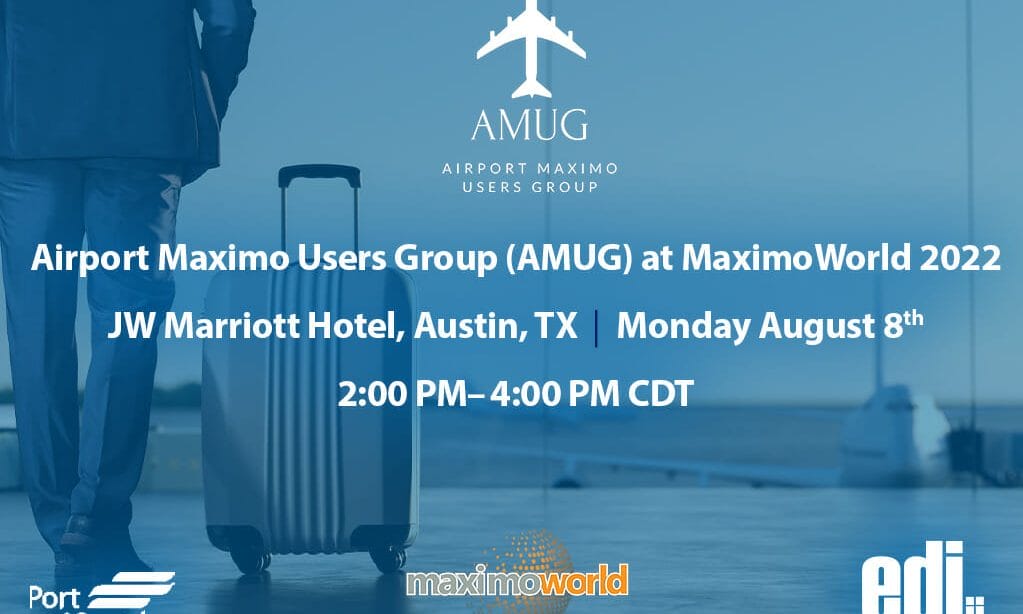
Joe Mahaz, PLSM, Founder and Senior Advisor at EDI, will be leading the upcoming Airport Maximo User Group Meeting at MaximoWorld 2022 in Austin, Texas. The meeting will include news related to AMUG business, updates on the upcoming May 2023 spring meeting, and will feature a panel of airport leaders. The panel will discuss new innovations in their Enterprise Asset Management implementation and/or upgrades at the airports, and how the airports have adjusted to the new norm.

Date and Time: Pre-MaximoWorld Conference, August 8th, 2022 from 2:00-4:00 PM CDT

Location: JW Marriott, Austin, Texas, Hotel 2nd Floor Room 204

AMUG Steering Group

Chair: Mr. Joseph Mahaz, PLSM – Founder and Senior Advisor, EDI

Co-Chair: Ms. Brendalynn Taulelei, MBA –  Senior Manager, Asset Management and Logistics Aviation Maintenance, Port of Seattle 

Agenda
  • Introductions
  • AMUG Business
    • General Discussions
    • May 2023 Spring Meeting – Seattle
Airport Panel Open Discussion
Open DiscussionsIf you have any questions, please contact events@reliabilityweb.com
LinkedInTwitterFacebookEmail

Salt Lake City Int’l Supports New Terminal With New Enterprise Asset Management Software

Enterprise Asset Management Software

Salt Lake City Int’l Supports New Terminal With New Enterprise Asset Management Software

Enterprise Asset Management Software

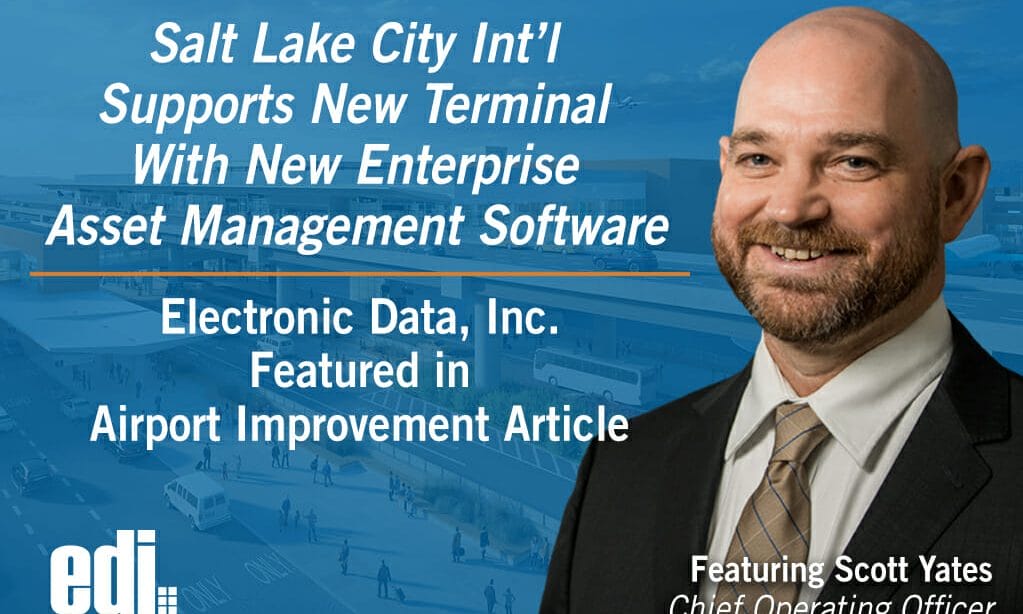
Electronic Data, Inc. (EDI) was featured in an article by Airport Improvement entitled “Salt Lake City Int’l Supports New Terminal With New Enterprise Asset Management Software.” Salt Lake City International Airport (SLC) began the transition for a new enterprise asset management system by working with a consultant to outline the functional and technical requirements. Ultimately, SLC chose the Maximo system.

Having launched the previous system on its own, SLC wanted a partner with experience implementing asset management systems at other airports to lead its upgrade. After considering multiple options, the airport contracted EDI for planning, configuration, testing, training, deployment and post-deployment support.

Scott Yates, Chief Operating Officer of EDI, is featured in the article, saying he considers it a major victory for SLC to have the new system operational just three months after the purchase contract was signed. “The airport didn’t lose the opportunity to get good maintenance history about this new facility,” he explains. “Had we not done that, they’d be keeping a lot of paper records and might never get the data into the system.”

Ultimately, SLC will be able to tie smart assets around the airport into Maximo. For example, sensors can be placed on baggage handling equipment, people movers or passenger boarding bridges to gather usage information that will drive maintenance decisions. Yates explains that such information will help SLC proactively head off failures, optimize preventative maintenance and provide better operational metrics.

LinkedInTwitterFacebookEmail

On-Premise Asset Management vs. Asset Management in the Cloud

Asset management in cloud

On-Premise Asset Management vs. Asset Management in the Cloud

Asset management is a crucial yet complicated part of business operations in practically any industry. When the business grows, expands, and handles remote tasks, it can be difficult to determine which asset management solution a company should use, and whether it should be hosted on-premise or in the Cloud.

Let’s review the two hosting options, why managing media assets in the Cloud may be beneficial, and why some companies prefer on-premise control of their asset management.

On-Premise Asset Management

On-premise asset management is the traditional method for managing the system. This type of asset management is self-hosted through the use of a company’s servers and is managed by the company’s internal IT team. Everything is handled in-house, which allows an organization to manage the system’s IT infrastructure.

Like any other system, this management type has its benefits and setbacks.

PROS

  • On-premise hosting allows for significant customization, integrations, and security protocols.
  • These systems may be ideal for companies that have an experienced IT team.
  • These systems might be extremely beneficial for businesses with hosting capabilities.

CONS

  • On-premise systems are expensive
  • The company is responsible for all integrations and maintenance procedures.
  • These systems take significant time to deploy.

Asset Management in the Cloud

Digital asset management in the Cloud is partially or completely managed by the vendor the company utilizes. Because these systems are hosted in the Cloud they reduce employee maintenance burdens and internal infrastructure costs.

PROS

  • Cloud-hosted asset management solutions are typically more affordable than on-premise systems, as these systems don’t require the company to have hosting capabilities.
  • They’re accessible remotely so employees can access the data they need from anywhere.
  • Cloud system vendors often provide much of the security protocols for the company, and IT asset management in the Cloud takes the demand off the company’s IT department.

CONS

  • Cloud-based system speed will depend on the user’s internet connection, so performance will suffer if files are accessed in a remote location with poor connectivity.
  • Shared servers may decrease the speed of a company’s system performance depending on how many companies are using the server at a time.
  • If using proprietary programs is a requirement, this could make migrating, editing, or exporting files complicated at first.

Each organization has different needs, so there isn’t a universal answer regarding which hosting type is best for asset management. Exploring the capabilities and restrictions of each asset management system is necessary to come to an informed decision about which method your company needs.

LinkedInTwitterFacebookEmail